Behavior-Based Trigger Logic vs. Time-Based Drip Sequences
Behavior triggers beat calendar schedules for onboarding conversions.
A drip fires because a calendar says to, not because the person on the other end did anything to earn it. Behavior-triggered logic works the opposite way: the message goes out because the product logged an action, or the absence of one, and that action is what decides what gets sent next. The difference sounds small until you look at what a fixed schedule actually assumes.
Every drip sequence runs on one hidden bet: time elapsed roughly equals progress made. Day 1 gets a welcome note, day 3 gets a nudge to finish setup, day 7 gets a feature tour, day 14 gets a check-in. The logic only works if everyone in the sequence moves at the same pace, and almost nobody does. Someone who finishes onboarding an hour after signing up still gets the "finish your setup" email on day 3, because the campaign doesn't know setup is done. Someone who hasn't touched the product in a week still gets the "getting started" tips on day 7, phrased for a person who's already three steps past that. Both are wrong in opposite directions, and both come from the same design flaw: the sequence was built to describe a typical user, and there's no such thing as a typical user once real behavior enters the picture.
The cost isn't just one awkward email. Repeated mismatches teach subscribers that the sender doesn't know what they've done, and once that pattern sets in, opens drop, spam complaints tick up, and deliverability suffers for every message that follows, including the ones that would have mattered. A well-built sequence needs an exit ramp the moment someone activates. Most drip campaigns don't have one. They just keep firing until the schedule runs out, regardless of whether the recipient needed step 4 five days ago or doesn't need it at all.
Behavior-triggered logic replaces the countdown with a question: what has this person actually done in the product, and what comes next for them, specifically? The calendar disappears as the organizing principle. Product events take its place.
What the activation gap costs, and why message timing is the lever
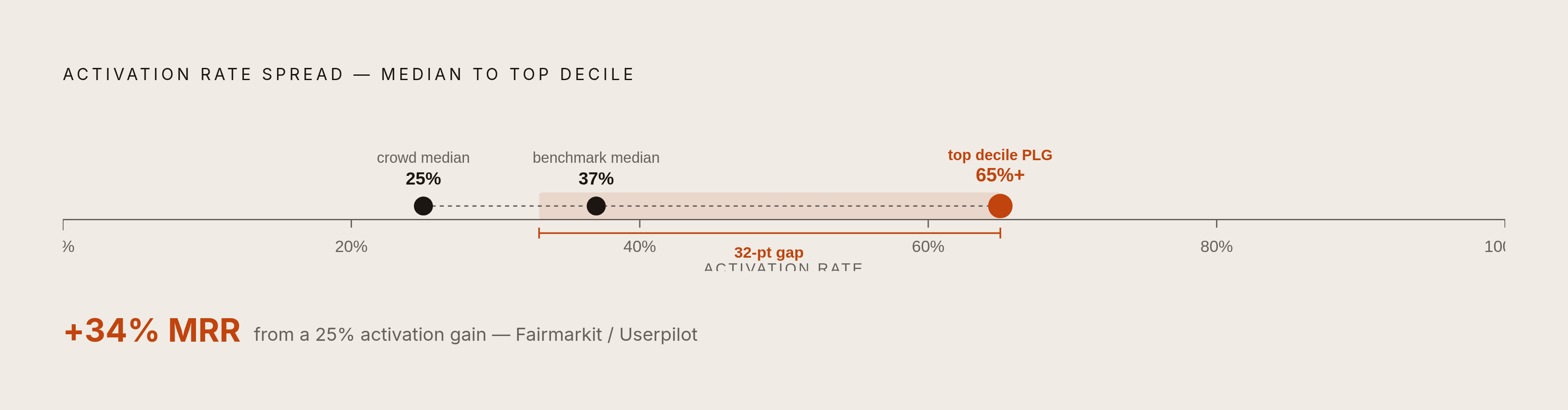
Activation is the point where a signup turns into someone who's actually using the thing, and most companies lose the majority of users before that point. Userpilot's 2024 benchmark, drawn from 62 B2B companies, puts median activation at 37%. A separate crowd-sourced survey published in Lenny's Newsletter found an average of 34% and a median of 25%. Read either number straight: something like two-thirds of signups never activate. They churn quietly, often without ever hitting a support ticket or a churn survey, because they simply stop coming back.
That gap has a price tag. Userpilot's benchmark cites research from Fairmarkit showing a 25% improvement in new-user activation drives a 34% increase in MRR. Activation is a lever that sits upstream of nearly all the real business metrics, not a vanity funnel stage above them. It's upstream of nearly all of them.
Timing shapes whether trials convert, with reaching first value within roughly 72 hours of signup identified as the single strongest predictor. Research identifies reaching first value within roughly 72 hours of signup as the single strongest predictor of trial conversion. OpenView's SaaS Benchmarks data sharpens that further: users who haven't completed the core activation action within 48 hours have a 70 to 80% chance of churning before the trial even ends. Two windows, 48 hours and 72 hours, both narrow, both different for every user depending on when they signed up.
A fixed drip schedule can't hit a window like that reliably. If message 2 fires on day 3 no matter what, it might land three hours after the user activated, which makes it noise, or two days after the 48-hour cliff already claimed them, which makes it useless. The window has to be measured from the user's own clock, which means the trigger has to fire off something the user did, not a date on a send calendar.
The gap between good and great is large enough to change a company's growth curve. The top decile of PLG companies activate at 65% or higher; the average is 33%. A 32-point spread, compounding through expansion revenue and referrals, is not a rounding error. It's the difference between a product that grows on its own and one that has to be pushed uphill by sales and marketing spend.
How behavior-triggered logic works: the three trigger types
Once the calendar is off the table, what actually needs to be figured out changes. It's no longer "how many days since signup." It's "what has this user done, and what's the next logical step from here."
Trigger design breaks into three working categories. Activation triggers fire the moment someone completes a meaningful setup step, connecting an integration, importing a data file, inviting a teammate, and they unlock whatever comes next immediately, rather than waiting for a scheduled day to roll around. Stall triggers fire when forward motion stops: a user finishes step one, then goes quiet on step two for 48 hours, and the message that follows addresses that specific stall point instead of restarting the whole pitch from the top. Success triggers fire once someone reaches the milestone that correlates with sticking around long term, the so-called aha moment, which should be defined from the product's own retention data rather than guessed at.
Layered on top of that, four broader event categories appear across most SaaS products: signup events, trial events (activation milestones, trial-expiry countdowns), billing events (payment success, payment failure, plan changes), and churn signals (inactivity crossing some threshold, or an outright cancellation).
None of this requires building a 40-node decision tree on day one. Most SaaS products get most of the available lift from five to eight well-chosen triggers. Start there, watch what happens, and expand only where the data says it's worth it.
Not every signal belongs in an automated flow, either. A user who hasn't logged in for 10 days and never finished setup isn't a job for another email. That's a deep stall, and the right move is to pull the person out of automation and hand them to someone on the team who can actually ask what's wrong. Automation is good at scale and bad at judgment, so the escalation rule matters as much as the trigger rules do.
Suppression deserves the same weight as sending. The sequence has to drop a user the instant they activate. An automated "finish setting up your account" message landing in the inbox of someone who finished setup yesterday doesn't just waste a send, it actively damages trust in every message that follows.
What the performance data shows when triggers replace the calendar
The performance gap between triggered and scheduled messaging is not subtle. Customerscore.io reports behavioral email sequences, triggered by user actions, convert at two to three times the rate of time-based drips, a figure that lines up with HubSpot's State of Marketing 2025 findings on the same comparison.
Vendor-reported numbers need to be read with the source attached. Figures circulating from Userpilot and from Customer.io point to as much as 30% higher conversion and several times higher engagement for behavior-triggered email versus scheduled sends. Those are company-published figures, not independent academic studies, so treat them as directional rather than as something to put in a board deck without a footnote.
Segmentation compounds the effect. Drip's Marketing Automation Report found merchants running two or more audience segments earned 17 times more revenue than merchants running just one. Trigger logic and segmentation aren't competing approaches, they stack: a trigger tells you when to send, a segment tells you what to say, and doing both badly beats doing either one alone.
On the PLG side specifically, OpenView's 2025 SaaS Benchmarks put median conversion for automated, triggered sequences at 22 to 25%, against 8 to 12% for manually run cadences. That's roughly a two-to-threefold gap, consistent with the broader behavioral-versus-scheduled comparison above.
One honest caveat belongs here. Conversion lift after a triggered message is well documented across these sources. Proof that the message caused the lift is a harder claim to make, since a user who was already about to activate and then received a well-timed nudge looks identical, in most datasets, to a user the nudge actually moved. Correlation is the claim the data supports. Causation is a stronger claim than most of these numbers can carry on their own.
The inputs that make triggers work: combining database state with behavioral signals
Triggers need two different kinds of information running together, and neither one alone is enough. Database state tells you what should be true: the plan someone's on, their role, whether a given feature is even available to them. Product analytics tells you what's actually happening: what they've clicked, how often, how recently.
The interesting signal usually lives in the gap between the two. A user whose plan includes a reporting feature but who has never opened it once is in a completely different situation from a user who opened it, poked around for thirty seconds, and never came back. Both look identical if you're only checking plan entitlements. Only the behavioral layer tells them apart, and each one calls for a different message.
In practice, the inputs feeding a trigger system come from a handful of places: account-creation webhooks, product analytics, a payments provider, and usage logs. Mixpanel's event-based tracking, for example, captures behavioral detail that defines a product-qualified lead, and some teams build those PQL definitions directly in-platform to route qualifying users to sales in real time.
The harder problem is getting engineering, product, and growth to sit down and agree on what an event actually means, what counts as "activated," what counts as a "stall." It's getting engineering, product, and growth to sit down and agree on what an event actually means, what counts as "activated," what counts as a "stall." That alignment takes longer than any integration does, and skipping it is why plenty of trigger projects stall out before they ship anything.
None of this demands ripping out existing instrumentation and starting fresh. Most teams can build a working trigger system on top of the database and analytics they already have. The catch is that the existing data has to be clean and consistently defined, because a trigger built on messy event names or inconsistent plan fields will misfire in ways that are hard to trace back to the source. Even a basic setup, a product analytics tool feeding a lifecycle email platform such as Customer.io, Braze, or Intercom, needs real engineering time to wire together, and the effort grows from there.
Channel selection: when to trigger in-app versus email
The channel choice follows a fairly simple rule, per Customer.io's own framing: reach active users in-app, especially for anything time-sensitive, and use email to reach people who aren't currently in the product or to explain something that needs context before they log back in.
Feature adoption itself isn't a single event, it's a three-stage process. Announcement is the moment a user learns a feature exists. Education is when they learn how to use it and why it's worth using. Reinforcement is the repeated use that eventually turns it into habit. Each stage calls for a different trigger condition, and often a different channel.
A concrete case: a user visits the reports page three separate times but has never clicked Export. Triggering an in-app overlay near the Export button at the moment of that third visit is education delivered exactly when it's relevant. Sending a generic "did you know you can export reports" email three days after signup, regardless of whether the person has even looked at reports yet, is noise.
The same logic applies to walkthroughs. Keep them short, make them skippable, and trigger them off behavior rather than off the clock. A walkthrough that appears the first time someone opens a feature is doing its job. A walkthrough that appears on day 3 whether or not the person has touched that feature is just another thing to click past.
The strongest setups use both channels, with different messaging on each, all governed by the same underlying trigger. The channel is a delivery decision that follows from the user's state. The content calendar shouldn't be making that call.
Measuring feature adoption beyond opens and clicks
Open rates and login counts tell you someone showed up. They don't tell you whether the product earned a place in that person's actual workflow, which is a different and much more useful question.
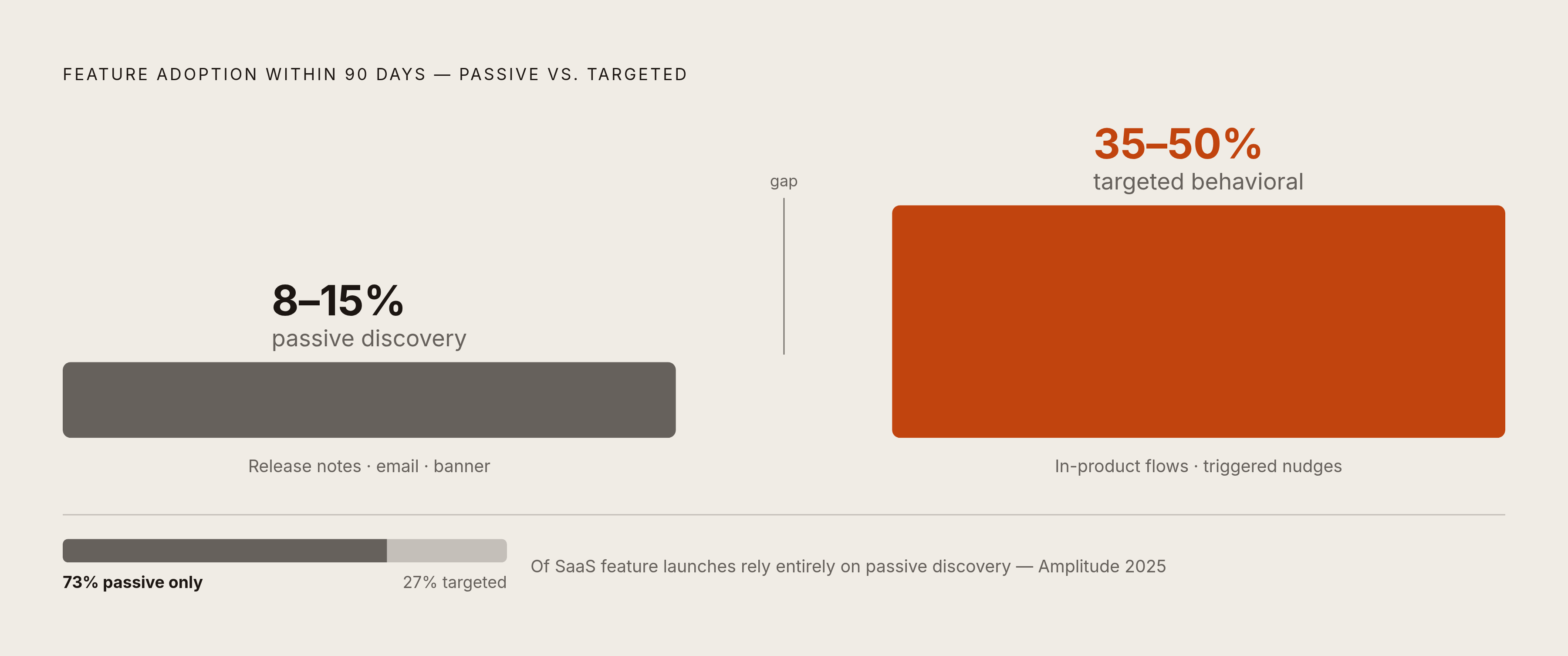
Amplitude's 2025 product analytics benchmarks found that 73% of SaaS feature launches rely entirely on passive discovery, release notes, an announcement email, an in-app banner, and hope. Only 27% pair a launch with any kind of targeted behavioral campaign. The performance gap between the two is stark: passive launches reach 8 to 15% feature adoption within 90 days, while targeted behavioral campaigns reach 35 to 50% in the same window, according to Gainsight customer success data. That's not a small edge from doing the extra work. It's most of the difference between a feature that sees real usage and one that quietly gets ignored.
Userpilot's product metrics benchmark puts average core feature adoption at 24.5% across SaaS products, with the top quartile clearing 45%. And the reason most features fall short usually isn't the feature itself, adoption failures commonly come down to discoverability, not some inherent lack of value. That's an important reframe. The fix, most of the time, is trigger relevance and timing, not another product redesign.
The formula worth using is distinct eligible users or accounts that reach meaningful use, divided by distinct eligible users or accounts in that same window, times 100. "Eligible" Since plenty of products gate features by plan, role, or permission, counting ineligible users in the denominator quietly deflates the real number.
Early behavior predicts later retention with real force. Features that see repeated use within the first 7 days show several times higher 90-day retention than features where repeat engagement is delayed, per Amplitude's behavioral research. That leading indicator is the one to watch, well before the 90-day number is even available to look at.
Depth matters alongside frequency. An account touching one or two features narrowly signals a use case that hasn't expanded past its original reason for buying. An account using many features often and consistently is the clearest sign of real adoption, the kind that tends to renew and expand rather than churn quietly at renewal time.
And the honest caveat from earlier applies here too: a message correlated with a behavior change is not proof of causation. The defensible measurement tracks eligible-cohort adoption and repeated real use, not just whether an email got opened.
Building a trigger architecture that doesn't require starting over
Everything above depends on one definition getting nailed down first: what does "activated" actually mean for this specific product? "Completed onboarding" predicts nothing on its own, it's too vague to point a trigger at. What matters is a single, observable action that correlates with 90-day retention in the product's own data, the kind of thing you get by finishing the sentence "a new user is activated when they ___" with something concrete and measurable. Every trigger in the system should point back to that one sentence.
From there, segmentation by two or three attributes usually does more work than a dozen minor tweaks to message copy. Role at signup splits behavior immediately, an admin and an end user want completely different things in week one. Company size matters too: a solo founder moves through a product differently than a five-person team does. Acquisition source matters as well, since a self-serve PLG signup and a sales-assisted signup arrive with different expectations already set. SEM Nexus notes the role split alone tends to produce the single biggest personalization lift of the three.
Activation benchmarks vary sharply by vertical, and Userpilot's 2024 data shows just how sharply: AI and ML SaaS activates at 54.8%, CRM and sales tools at 42.6%, MarTech at 24%, HR software at just 8.3%. The vertical a product sits in should determine how many triggers get built and over what window, not a copy-pasted "day 3, day 7, day 14" schedule borrowed from a blog post.
Onboarding flow length has a measurable cliff of its own. Chameleon's Benchmark Report found three-step product tours finish at around 72%, while seven-step tours collapse to about 16%. Every step added past the core activation path is a place users fall out, and the data says that drop-off isn't gradual, it's steep.
PLG and sales-led motions don't have the same problem to solve. Sales-led companies out-activate PLG companies, 41.6% versus 34.6%, but PLG companies out-retain them on one-month retention, 48.4% versus 39.1%. Trigger architecture has to be built for whichever problem the team is actually facing, getting users over the activation line in the first place, or keeping them once they're across it. Building for the wrong one wastes the whole exercise.
Personalizing onboarding by role or intent can lift 7-day retention by as much as 35%, which is not a marginal tweak, it's close to the size of effect a full product redesign might chase.
The next layer past static trigger rules is an adoption agent: something that investigates each eligible person individually, reading their current database state and behavioral history, and writes a grounded, specific message only when the evidence actually supports sending one, skipping the ones where it doesn't. The team doesn't approve every individual message that goes out. It approves the campaign's goal, its audience, its guidance, and its limits, and the agent operates inside those boundaries.
Whatever architecture gets built, the outcome has to be measured in the product, not in the inbox. The real question was never whether the email got opened. It's whether behavior in the product actually changed.
Sources
- SaaS Onboarding Email Sequences: 2026 CRM Playbook
- Onboarding Automation: Reducing Time-to-Value for SaaS Users | SEM Nexus
- SaaS Onboarding Best Practices for B2B | Customerscore.io
- Behaviour-Triggered Emails vs Drip Campaigns
- Automate SaaS Free Trial Onboarding & Activation in 2026
- SaaS Onboarding Email Sequence to Cut Churn | sendXmail
- artisangrowthstrategies.com