Structuring the Campaign Logic Behind Event-Triggered Onboarding Emails
Better event-triggered onboarding starts with the logic layer, not the email design.
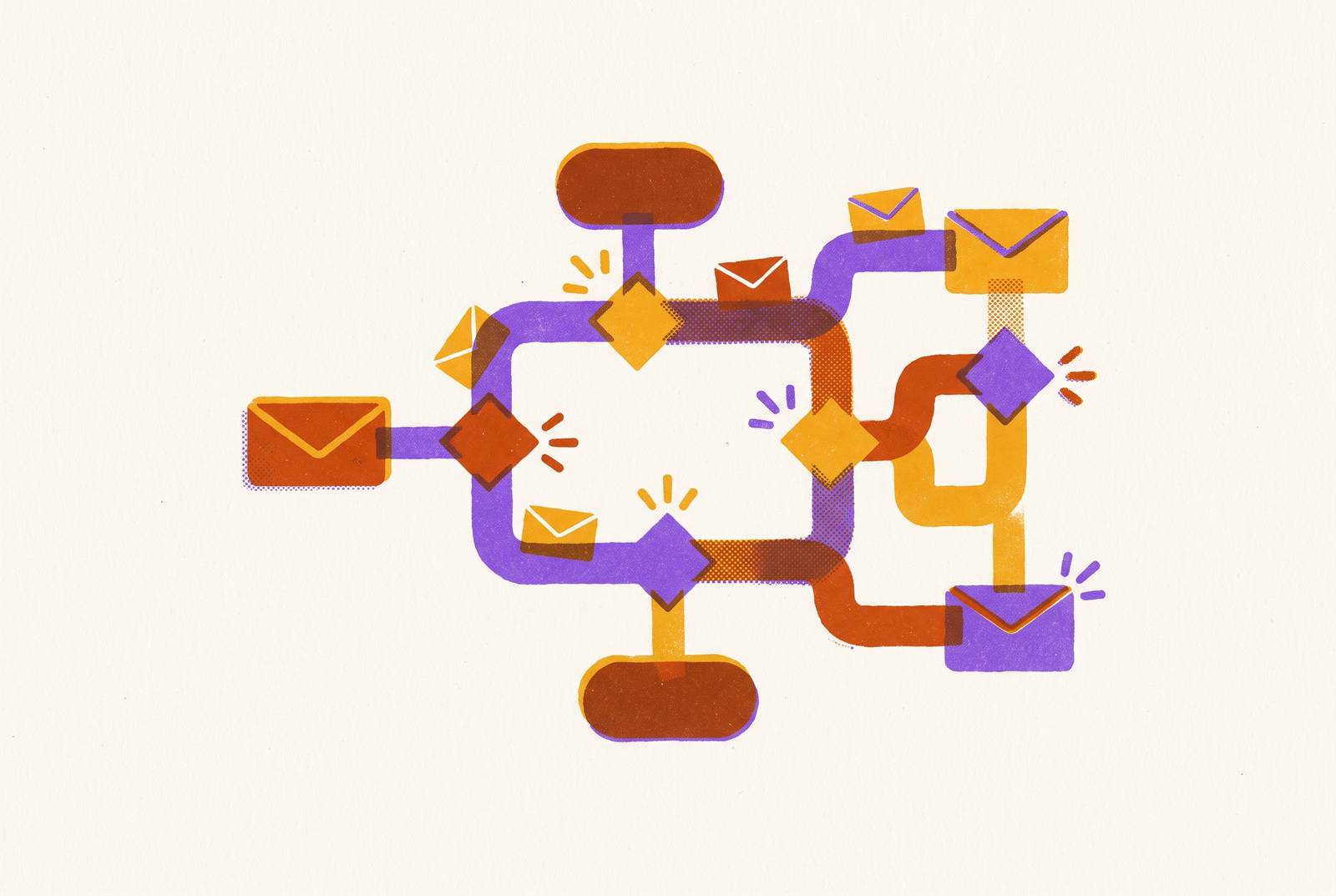
Most teams building event-triggered onboarding spend their time on the email and treat the rules around it as an afterthought. The copy gets workshopped, the subject lines get tested, the design gets approved, and the decision logic that determines when a message should fire and to whom gets bolted on at the end or skipped.
The failure mode shows up in a specific way. A sequence gets labeled "behavior-triggered" when it's really a time-based drip wearing a behavioral disguise. Nothing about the sequence is actually watching the user.
The consequence lands fast. A better subject line will not fix that. The fix is a logic layer built before a single email gets written: definitions for what counts as a milestone, conditions for routing different users down different paths, rules for suppressing sends that don't make sense, and gates that exit a user the instant the goal is met.
The components of the logic layer and why each part is load-bearing
The campaign logic layer has four components, and each one can fail on its own without the others showing any sign of trouble.
Activation event definitions set what counts as a milestone. A sequence without a precise answer to "what does success look like" cannot trigger on success at all, so this piece has to come first.
Branching conditions decide which path a user takes based on where they actually stand. A user who has hit the milestone needs a different message than one who hasn't, and a sequence with no branching sends the same content to both.
Suppression rules stop a send from going out when it shouldn't, regardless of what the branch logic says. Plan eligibility, role, quiet hours, frequency caps sit above the branching logic and can override it.
Skip-if-succeeded gates remove a user from the sequence the moment they achieve the goal, independent of how many emails were scheduled to go out. This is the piece most often missing, and it most directly shapes whether the sequence feels helpful or feels like noise.
Each of these four parts is load-bearing. Get the activation event wrong and the whole sequence optimizes for the wrong outcome. Get suppression wrong and the sequence actively damages trust. The sections that follow build each one in order.
Defining activation events precisely enough to trigger on them
An activation event only works as a trigger if it's a single, instrumentable product action, not a sentiment, not a session, not a login. A system needs to be able to record it as true or false at a specific moment. If the event can't be written as something close to a product analytics call, like project_created or integration_connected or first_report_run, the definition is still too abstract to build a trigger around.
Slack's activation event was 2,000 messages sent by a team. An activation event like Slack's measures whether the product became part of how a team actually works.
A common trap is defining activation as something the team controls, like profile completed or payment method added, rather than something the user chooses through genuine use. That produces inflated activation numbers that don't correlate with retention, because the team is measuring compliance when it should be measuring value realization.
B2B products carry an extra layer of complexity here: activation needs a definition at the user level and a separate one at the account level. A single champion finishing setup doesn't mean the account is activated. Conflating those two produces trigger conditions that look fine on a dashboard and misfire in practice, sending account-wide messages based on one person's individual progress.
The output of this step should be written down: the event name, the conditions that must hold true for it to count, and whether it's measured against a user or an account.
Wiring product events into the CRM so triggers reflect reality, not assumptions
A trigger is only as good as the pipeline that tells the email system the milestone happened. Without deliberate wiring, most CRM contact records reflect what a user did at signup and nothing since. The record goes stale the moment the user starts actually using the product.
Three patterns handle this in production, and each carries a different cost and maintenance trade-off. A CDP or event pipeline has the product emit events to a customer data platform, which then fans them out to the CRM and the email system. Webhooks fire an HTTP call on each milestone event straight to the CRM or email tool's inbound endpoint. A direct API call has the backend talk straight to the CRM or email platform's API to set a contact attribute or kick off an automation. This gives the most control and comes with the most code to maintain.
None of these three is universally correct. The right choice depends on which one the team can keep running reliably, not which one looks cleanest on an architecture diagram. A webhook that silently drops events on failure is worse than a direct API call that fails loudly, because a loud failure gets fixed and a silent one just produces a sequence that quietly stops working.
The data contract requires precision: a product event updates a contact property in the CRM, and the email automation fires because that property changed, not because a fixed number of days passed. That one distinction is what separates a behavioral trigger from a drip campaign dressed up to look like one.
The most common failure here is treating the wiring as an ongoing dependency that gets neglected after the initial setup. When the product team renames an event or changes its schema, the trigger stops firing and nothing announces that it happened.
Building branching conditions that give different users different paths
A sequence with no branching is a broadcast wearing a disguise. Every user who enters gets the same emails in the same order, and any behavioral data collected along the way sits unused.
The simplest version of branching has two paths: users who completed the target action and users who haven't, checked at each wait step before the next email goes out. Users who haven't get a more direct intervention, which can eventually include a human touch, a reply from a real person, or an offer of a call.
A more mature structure adds a third path for users who are actively progressing but haven't yet hit the milestone. These users don't need a re-explanation of a feature they're already using. They need encouragement that acknowledges the progress they've already made.
Compound triggers sharpen this further, especially for expansion conversations. A condition like "user created a project and invited a teammate but has not upgraded" identifies someone who found real value and looks ready for a conversion conversation. That's a different user than someone who activated and never went any further, even though a simpler branch structure would treat them identically.
Role and plan belong in this logic too, particularly for B2B sequences. That user can't complete the action, progress stalls, and trust in the sequence erodes along with it.
Every branch needs an exit condition. Without one, users accumulate in limbo states indefinitely, sitting in a path that no longer matches their behavior because nothing was built to move them out of it.
Designing suppression rules that prevent the sequence from working against itself
Suppression logic protects the integrity of the whole sequence. A message sent to the wrong person at the wrong moment doesn't just waste a send, it actively damages the trust the sequence exists to build.
A few categories of suppression appear repeatedly in mature sequences. Milestone suppression stops a message when the user already completed the action it's meant to prompt, and this is the most common omission and the most damaging one. Quiet hours restrict time of day and day of week at the moment of send, not at the moment a message gets queued. Never-contact flags hard-exclude anyone who opted out, anyone flagged for sensitive account handling, or anyone in an active sales or renewal conversation.
These rules also need to respect what kind of message is being sent. Product lifecycle email sits in between those two categories, and conflating the three is the most common deliverability mistake in SaaS email. Suppression needs to account for the category of the message, not just whether the contact is currently enrolled in a sequence.
The suppression check belongs at the send gate, evaluated right before the message goes out, not baked into the audience definition at enrollment. A filter applied only at enrollment misses every change in the user's state that happens between enrollment and the actual send.
Calibration matters here too. Reviewing suppressed-send logs on a regular basis is the only way to tell an appropriate skip from a false positive.
Building skip-if-succeeded gates that exit users the moment the goal is reached
A skip-if-succeeded gate does a different job than suppression. Suppression stops a send because the message doesn't make sense to send. A skip-if-succeeded gate removes the user from the sequence entirely because the sequence already did its job, and letting it continue would work against the outcome it just produced.
This gate has to be checked at send time, not at enrollment. The gap between those two timings is exactly where "finish your setup" emails get sent to people who already finished, which is one of the fastest ways to make a well-built sequence feel like spam.
In practice, this means a real-time webhook or event listener that updates the milestone property on the contact and triggers an immediate exit from the workflow, bypassing anything still queued to send.
Exiting the sequence shouldn't be the end of the story. The system should move the user into whatever comes next: habit-building content, an expansion prompt, or a multi-user activation path, chosen based on which milestone was just hit.
B2B accounts need this gate evaluated at both the user and account level. A sequence that keeps running after a user has already succeeded is just persisting out of inertia, which is what separates a sequence built around logic from one built around a messaging calendar.
Measuring whether the logic layer is working, using adoption outcomes rather than email metrics
The real measure of a campaign logic layer is whether eligible users complete the target activation event at a higher rate than they would have without the sequence.
Getting the denominator right matters as much as getting the numerator right. Measuring against ineligible users deflates the number and produces a picture of the sequence that looks worse than reality.
A small set of metrics connects the logic layer to real outcomes. Retained adoption divides activated users still active in a later period by the activated users from the starting cohort, confirming that the activation was real and not a one-time spike.
Open rates carry almost no weight as a primary signal for a sequence like this. Apple Mail Privacy Protection inflates them to the point of unreliability, so the credible stack runs in-product event completion first, click-through second, and open rate a distant, heavily caveated third.
One diagnostic pattern worth building into a regular review is that if trial rate is high but thirty-day repeat usage is low, the issue is usually discoverability timing rather than awareness. The sequence is reaching people, and they're completing the activation event, but the behavior never becomes habitual. That calls for a habit-building branch after the skip-if-succeeded gate fires, not more pre-activation nudges.
The activation events defined at the start of this process are the same events measured here at the end. A team that can't measure an outcome has no business building a trigger around it.
Putting the logic layer together: the sequence architecture that connects all four components
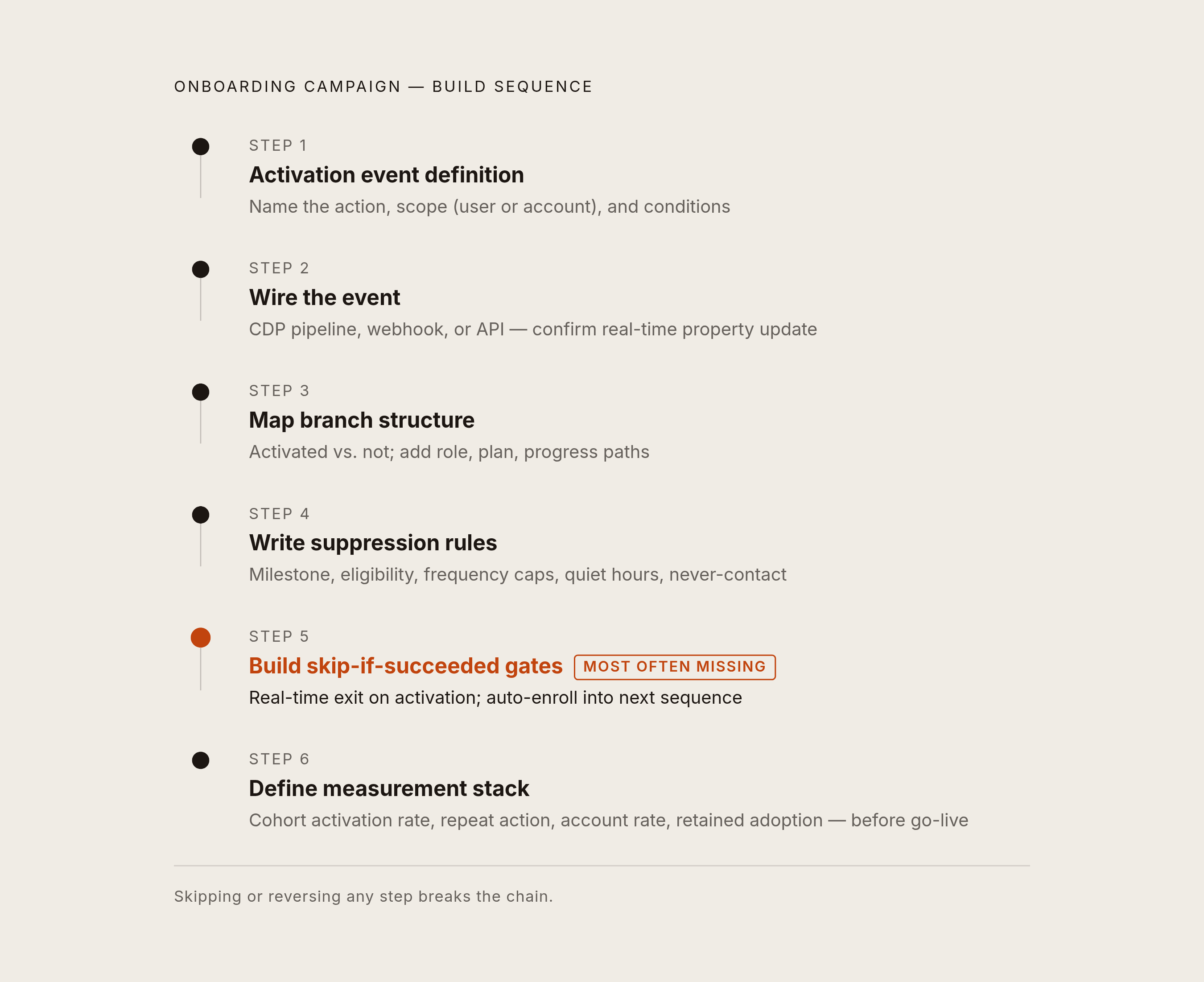
A complete event-triggered onboarding sequence gets built in a fixed order, and skipping or reversing a step breaks the chain that holds the rest together.
Step 1 is writing the activation event definition, naming the single instrumentable action, specifying whether it applies to a user or an account, and setting the conditions that must hold true for it to count. Step 2 is wiring the event, choosing between a CDP pipeline, a webhook, or a direct API call, and confirming the contact property updates in real time. Step 3 is mapping the branch structure, starting with the minimum two paths of activated and not activated, then adding the paths warranted by role, plan, and progress state. Step 4 is writing the suppression rules, covering milestone, eligibility, frequency caps, quiet hours, and never-contact flags, confirmed to run at send time. Step 5 is building the skip-if-succeeded gates, with a real-time exit on the activation event and automatic enrollment into whatever sequence comes next. Step 6 is defining the measurement stack, covering eligible-cohort activation rate, repeat key-action rate, account activation rate, and retained adoption, settled before the sequence goes live.
A sequence built this way fires on what the user actually does, not on a calendar. A user who publishes a first asset on day two gets the "now share it" prompt on day two, not on day seven because a schedule said so.
Every send decision in this architecture has to be justified by what the system knows about that specific user's current state. Being in the audience for a sequence is a necessary condition for a send, never a sufficient one on its own.
Building this takes real upfront investment: defining events precisely, wiring them reliably, mapping branches, writing suppression rules, building exit gates, and setting up measurement before anything goes live. That investment sits in the logic layer itself, which can be reused, audited, and improved over time. A human reviewer checking each send by hand cannot scale to every user in an eligible cohort. A logic layer built this way can.