Role and Job Function Signals in Message Personalization
Combine role data and behavior signals to guide users beyond their job title.
That's the wrong layer to put it at. Role data works best as a live signal that, combined with what someone actually does in the product, tells you what they need next, not which permanent path they're stuck on.
Role data versus behavioral data: a different layer
The standard onboarding move, and it's nearly universal, is to ask for job title or department at signup, route the user into the track that matches, and treat that assignment as done. It feels rigorous. It has a segmentation label attached to it and a corresponding email sequence, so it looks like personalization.
But role data is static. A signal hierarchy exists here. Role and function data is what ZoomInfo's 2026 personalization guide calls the contact data layer: stable, available immediately, and directly predictive of which features are likely to matter to this person. Behavioral data is different in kind, not just in timing. It accumulates. It shows what the person actually does, which may or may not line up with what their title suggested.
The gap between those two layers, what the role predicted versus what the behavior shows, is where the useful guidance actually lives. Role is a prior. It's a prior. Behavioral data is the thing that confirms it, contradicts it, or sharpens it into something specific.
The role of signals before a user touches the product
At the moment someone signs up, before any click has happened, role data is doing real work. It's a solid predictor of which features will feel relevant to this person's job, and which metrics they'll care about first. A CFO wants ROI and cost. A CTO wants architecture and integration details. A VP of Sales wants pipeline velocity and whether reps are actually adopting the tool. Role also tells you which empty states and demo data will feel recognizable versus alien on first login.
What role signals cannot tell you is whether this person is the daily user, a secondary user who logs in twice a month, or an evaluator who has no intention of ever touching the product themselves. It cannot predict which workflow they'll actually open first, regardless of what their title implies. And it cannot guarantee that behavior downstream will match the segment their role suggested they'd land in.
Userpilot's 2026 product personalization guide describes the common failure mode directly: a user self-identifies as a marketer in a welcome survey, gets routed into a marketing path, and the product keeps treating them as a marketer for the rest of their lifecycle, regardless of what they actually go on to do. Their own phrasing is blunt about it: customer data from day one doesn't age well. Role data is a strong prior for that very first interaction. Left frozen, never revisited, it turns into a liability.
The fix is to treat role data as a starting hypothesis, one that product behavior is free to confirm or override once real usage starts generating evidence. It's to treat it as a starting hypothesis, one that product behavior is free to confirm or override once real usage starts generating evidence.
How multi-stakeholder buying committees make role signal complexity unavoidable
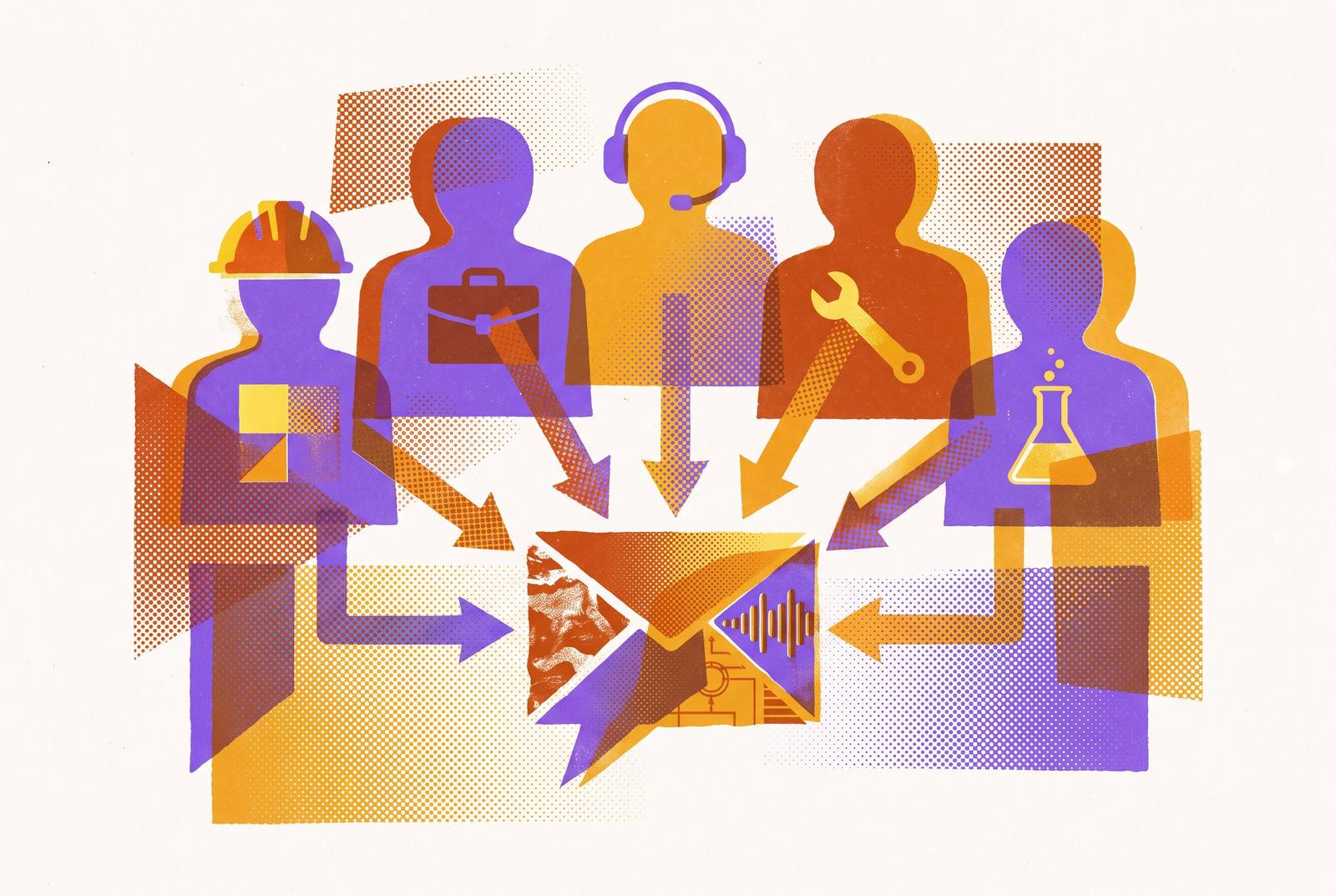
That's not a small group making one shared decision. Each person on it walks in with a different definition of success. The economic buyer wants ROI and budget impact. The technical evaluator wants integration details, security posture, architecture fit. The end user just wants the thing to work inside their existing workflow without adding friction.
Gartner's B2B buying journey research, cited in Autobound's guide, found that more than 52% of buying groups now include decision-makers at VP level or above BetterCloud / Wellows. What they do is read the reports it generates, and their read on those reports is what decides renewal BetterCloud / Wellows.
One onboarding track cannot serve all of these people, even when they're all using the exact same product. Role signals are the only data available the moment an account enters the system, so they're what has to do the initial differentiating.
A deeper wrinkle sits underneath this, though. Once these people are actually inside the product, behavior starts to pull away from title. The VP expected to be a passive report-reader might turn into an active configurator, tweaking settings nobody expected them to touch. The end user assumed to be the primary daily driver might log in once a week and nothing more. That divergence is the normal condition of how these accounts actually behave. It's the normal condition of how these accounts actually behave, and it's exactly why behavioral data has to pick up where role data leaves off.
What happens when behavior contradicts the role hypothesis
Picture the failure pattern, because it's common and it's specific. A user signs up and says "I'm an engineer." The product routes them into a technical onboarding track. That track never surfaces the collaboration features this engineer actually needs to pull teammates into the tool. The engineer activates alone, hits the point where the product needs a team around it to keep delivering value, and churns right there.
Userpilot's 2026 guide names the broader symptom: products that route by role at signup and never re-evaluate produce a pattern of high logins and zero outcomes. Activation metrics look fine on a dashboard. Growth and adoption stall anyway, with no obvious explanation, because the explanation was never in the dashboard to begin with.
When a user's actual path in the product keeps diverging from what their role-based segment predicted, treat that divergence as information, not as noise to be routed back to the segment default. The combined signal should work like this: role establishes which features get surfaced first, and behavior, what got clicked, what got skipped, what the user kept circling back to, decides which features get surfaced next. A message sent on day 7 or day 30 ought to reflect what the person actually did, not what their job title predicted they'd do.
There's a real number attached to getting this right. Average core feature adoption is 24.5%, per Artisan Growth Strategies' benchmarks, while top-quartile performers clear 45% Madison Logic research Appcues 2025 data / US Tech Automations Gartner / Userpilot BuildBetter AI / Gainsight market analysis. That gap points to a calibration story. It's a calibration story, how well the guidance a user receives keeps adjusting to them individually after signup, instead of freezing at the segment they were dropped into on day one Madison Logic research Artisan Growth Strategies Appcues 2025 data / US Tech Automations Gartner / Userpilot BuildBetter AI / Gainsight market analysis.
Using role signals to set the first message, not the permanent path
Role data earns its keep at the very start. Use it to pre-populate the product with demo content that feels immediately recognizable to this specific role, which cuts down the cognitive load before any behavioral data even exists to lean on.
Userpilot's 2026 guide states that persona-based personalization that pre-loads role-relevant content works because it removes the "imagine how this applies to your job" burden at precisely the moment users are most likely to bounce.
Format is not a footnote here, either. ProductLed's PLG benchmarks, cited in the lumi.studio onboarding guide, found welcome screens hit a 56% tutorial completion rate, checklists land at 36%, and tooltips trail at 31% ProductLed 2025 PLG benchmarks / Lumi Studio BuildBetter AI / Gainsight market analysis. The exact same role-informed message, delivered in the wrong format, may simply go unconsumed.
What the first message should never do is lock someone onto a rail the product then enforces no matter what they do afterward. It also shouldn't try to list every feature that role might conceivably want. That's a catalog, not guidance, and nobody reads a catalog on day one.
Once the user gets through that first session, role's job changes. Once the user gets through that first session, role becomes context sitting underneath whatever the behavioral signals are now saying, rather than the primary driver of what gets shown next. In setting the first message rather than the permanent path, role signals should be used to surface the 2–3 features most likely to produce this role's "aha moment" first, not every feature the product offers.
Behavior refining role context into a specific next step
The combination works like this, concretely. Role tells you this person probably cares about feature X. Behavior tells you they've opened feature X three separate times without ever completing the key action inside it. Put those together and the right message is a specific instruction, not a vague nudge like "have you tried X?"" It's a specific instruction: here's the exact next step to finish setting up X, given that the person has clearly already started and gotten stuck.
The trigger for that message matters as much as its content. Userpilot's 2026 guide is clear that the trigger for a contextual in-app message should be behavioral, fired when a user hits an actual friction point, not scheduled on a timer. Time-based rules generate messages that are role-relevant in theory and irrelevant in practice, landing whether or not the person is anywhere near ready for them.
The same logic governs when to introduce secondary features. Role tells you which secondary feature makes sense for this person eventually. Behavior tells you when they've actually reached the point where it's relevant, not before.
There's outside evidence for how much specificity is worth. Instantly's Cold Email Benchmark Report, cited in Autobound's signal-based selling guide, found that outreach anchored to what a recipient is actually doing right now gets an 18% response rate, against a 3.43% average for generic messaging. The claims (⟦cN⟧) referenced by the second sentence
And the discipline that makes this whole thing work is knowing when to skip. If the behavioral evidence doesn't support sending something, don't send it. Being in a role-based segment is not, by itself, sufficient reason to fire the next item on that segment's checklist.
This kind of judgment, per person, per moment, doesn't scale by hand. That's exactly where automation has to enter, because no team can run this evaluation across a user base in the thousands.
Automation's fit: an agent applying role-plus-behavior logic at scale
Applying role-plus-behavior reasoning to one user at a time is a judgment call. It requires reading that person's current state and deciding, right then, whether the evidence justifies a message. That's not something a set of static rules can approximate, and broadcasting role-segmented templates to a whole cohort is the opposite of this kind of reasoning.
An adoption agent does something structurally different from a dashboard. It reads each person's account state, role, plan, configuration, alongside their behavioral history, independently. It decides whether the combined evidence justifies a message for this specific person right now. It writes something grounded in what that person actually did, not in what their segment is assumed to need. And, critically, it skips people when the evidence is thin, so not everyone technically eligible in a role-based segment gets something sent to them.
That's a different category from CS analytics or product analytics tools, which hand a team a chart, surface who looks at risk, or flag which features are underused. An adoption agent hands the customer the next thing to do, grounded in their specific state and behavior. ChurnZero's customer success trends report describes this model, in the industry's own words, as "instantly prescriptive", which is a fair way to draw the line: descriptive tools tell a team something, prescriptive ones tell the customer something.
Adoption of this category is moving fast. Salesforce reports AI service agent adoption climbed from 39% of organizations in 2025 to 66% in 2026 McKinsey research ProductLed 2025 PLG benchmarks / Lumi Studio Salesforce / Azeon AI Gartner / Userpilot Deloitte 2025 Tech Value survey BuildBetter AI / Gainsight market analysis. Gartner estimates 40% of enterprise applications will carry embedded task-specific AI agents by the end of 2026, up from under 5% in 2025 McKinsey research ProductLed 2025 PLG benchmarks / Lumi Studio Salesforce / Azeon AI Gartner / Userpilot Deloitte 2025 Tech Value survey BuildBetter AI / Gainsight market analysis. That's not a niche experiment anymore, it's becoming the default architecture.
None of this removes the human from the loop, though, it just relocates them. A person approves the campaign's goal, its audience, the guidance it's allowed to give, and its limits, once. Inside that approved scope, the agent applies its own judgment per person. That's campaign-approved autonomy, not sign-off on every individual message, and it's also not the agent setting its own goals. An adoption agent built on exactly this state-plus-behavior model, Lumi among them, is a credible option for PLG and growth teams that need this logic running at scale without hiring more CS staff or bolting on a new instrumentation layer.
Good measurement when role and behavior are both in the signal mix
Open rate and click rate are the wrong metrics here. Open rate only tells you the subject line matched the role. Click rate only tells you the message sparked curiosity. Neither tells you whether behavior inside the product actually changed afterward.
The metric that matters is simpler to state and harder to measure honestly: did the person complete the target action after getting the guidance, and did they keep doing it. That has to be measured against the eligible cohort, meaning only the people who actually received a message in that context, not the entire user base. It also has to separate person-level adoption from account-level adoption. One power user inside an account adopting a feature is not the same thing as that feature spreading across the team.
A causal trap sits here directly. Observed adoption after a message went out is not proof the message caused it. Some of those users were probably already headed toward adopting the feature on their own. Honest measurement describes the change it observed without dressing it up as proven causation.
There's also a newer complication specific to this moment. Userpilot's 2026 metrics guide points out that AI agents increasingly generate synthetic product activity that inflates health scores and hides real adoption gaps. Any role-plus-behavior signal system that feeds agent activity into the same usage logs as human activity will run into this at scale. Teams need to separate what a human did from what an agent did on that human's behalf before drawing conclusions about adoption.
The full loop looks like this: a role signal correctly predicts which feature someone needs, a behavioral signal confirms they're actually ready for it, a message tells them the specific next step, and a measurement confirms they took it. Everything covered here is a piece of that loop. None of it is a substitute for closing it.