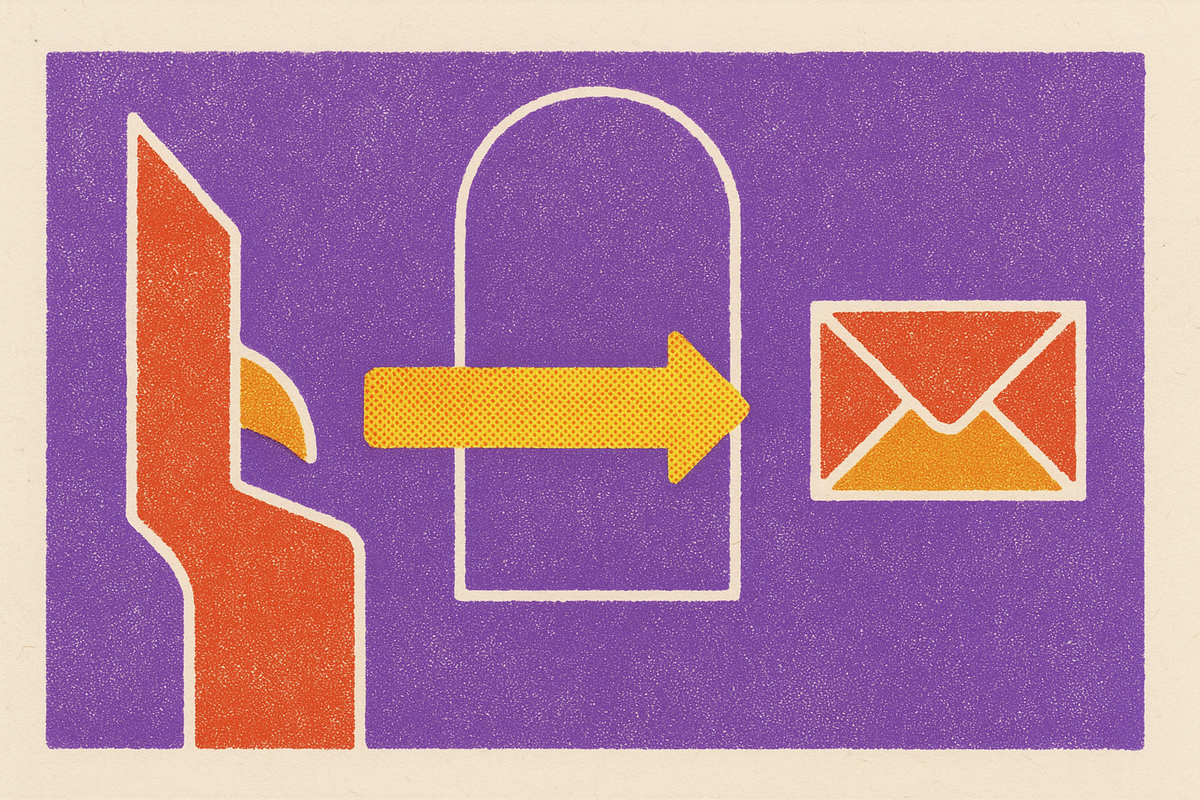
Triggered Slack Messages for B2B SaaS User Guidance
Behavior-triggered Slack messages convert hesitant users when they match context, not calendars.

Most B2B SaaS products lose users in the gap between signup and first real outcome, not because the product fails, but because nobody says anything useful at the moment it matters. Median activation rates for product-led growth companies sit around 37%, which means most people who sign up never reach the point where the product proves its worth to them. And users who don't engage within the first three days carry roughly a 90% chance of churning, so the window for a message that actually changes behavior is short. This piece is about how to use triggered Slack messages to fill that window with signal instead of noise.
Slack already sits where B2B teams do their work, so the instinct to deliver guidance there instead of email isn't wrong. But most Slack-based guidance fails for the same reason cluttered inboxes fail: it fires on a clock instead of on evidence, and it talks about what the product wants someone to do rather than what that specific person has or hasn't done. The result is a message that looks personal but reads as a broadcast, and recipients learn fast to ignore it or, worse, to resent it as a form of quiet surveillance. What follows is an attempt to answer a narrower question: what actually makes a triggered Slack message feel like help instead of noise?
What "triggered" actually means, behavior-based vs. time-based messages
A time-based sequence runs on a calendar. The "Day 3" email goes out on day three no matter what happened on day one, whether the user activated immediately or never opened the product again. It's the easiest system to build and the easiest one for a recipient to tune out, because it doesn't know anything about them.
A behavior-triggered message works differently: the send condition is a specific product event, or the conspicuous absence of one. Someone finishes a step, crosses a usage threshold, or goes quiet for a defined stretch, and that fact, not a date on a calendar, decides whether a message goes out at all.
For B2B SaaS, that leaves three broad categories worth naming. Completion events cover things like finishing an onboarding checklist, exporting a first report, or inviting a first teammate. Threshold events cover a usage limit coming into view, a new seat added, or a workflow abandoned halfway through. Absence events cover idle time past a set point, a workflow started but never finished, or a feature that's visible in the product but has never been touched.
A cleaner pattern than stitching together individual triggers is segment-join logic: define a segment once, say "active free users," and fire a message when someone enters it, then stop when they leave for the next segment, say "paying users." The condition gets set a single time instead of re-specified inside every campaign, which matters more than it sounds like it should, because campaigns multiply and nobody wants to audit twenty overlapping trigger definitions six months later.
Why does this matter more in Slack than it would in email? Slack carries a social contract that inbox marketing never earned. A message there feels like it's coming from a colleague, so a misfire, wrong timing, wrong person, wrong moment, costs real trust. A sequence that keeps nudging someone to "get started" after they've already activated doesn't just waste a send. It teaches the recipient that the channel isn't worth reading, which is a much harder thing to undo than a missed open rate.
The database state layer that makes behavior signals useful
An event tells you what somebody did. It does not tell you whether acting on that fact makes sense for this particular person, right now, given everything else true about their account. That second piece requires state, not just events, and it's where most triggered messaging systems fall apart quietly.
A handful of fields do most of the work. Plan and permissions determine whether the person can even use the feature you're about to recommend. Role determines the shape of the guidance itself. An admin needs setup instructions, an end-user needs help adopting a workflow, and an executive mostly needs to see outcomes, not steps. Account-level adoption tells you whether this person is the first on their team to try something or the fifth, which changes the tone of the message considerably. Configuration state tells you whether a prerequisite integration is actually connected, or whether the guidance you're about to send will land the recipient directly on a blocker.
A segment keyed to billing state (free versus active) combined with login recency, defined once and referenced across multiple campaigns, means the underlying logic doesn't need to be re-derived every time a new message goes out. That's a structural detail, but it's the difference between a system that scales and one that accumulates duct tape.
Skip that layer and the failure mode is predictable: a bulk-export tip lands on someone whose plan doesn't include bulk export, or whose admin never turned the feature on. Technically, the trigger matched a real behavior. Practically, it reads as a non-sequitur that costs trust for no return.
B2B adds a wrinkle that consumer products don't have to deal with. Individual activation isn't the finish line, account-level adoption is, and that means tracking which roles across an account have actually activated, not just whether any single person clicked through a checklist. Role-based onboarding paths, shaped by who someone is inside the account rather than by what they happened to click, outperform single-flow onboarding in activation by 30 to 50%. The path has to bend to the person, because a generic path built for an average user fits nobody in particular.
Designing a Slack guidance message that earns attention
A good message references what someone has done or hasn't done, but not as a readout of their activity log. The reference is evidence the guidance is relevant. "We noticed you exported records one at a time on Tuesday" reads as surveillance. Framing the same fact around what becomes possible now, or what's being left on the table without the next step, reads as help.
The structure that tends to work has a short list of ingredients, and it's worth being strict about all of them. One clear next step, not a menu of options and not a product tour prompt. A reason grounded in the recipient's actual situation, their role, their plan, what they've already built inside the product. A time or friction estimate when friction is the likely objection, something as plain as "takes under three minutes." And an obvious off-ramp, a way to reply, dismiss, or ask a question, so the message doesn't feel like a one-way broadcast landing in a channel meant for conversation.
Strip out generic encouragement (nobody needs "you're doing great!" from a bot), multiple calls to action, a link to the knowledge base standing in as the primary ask, or a feature overview nobody requested. Each of those dilutes the one thing the message is supposed to do.
Customers report a stronger likelihood of staying loyal, 86% in surveys on the topic, when they have a seamless onboarding experience. A triggered Slack message is part of that experience, not a separate marketing layer bolted onto it, and it should read that way. Progressive disclosure is worth holding onto as a working principle: surface only what's relevant to where someone stands right now. More advanced capabilities can wait until the prerequisites are actually in place.
How Slack fits into the broader tooling picture for triggered B2B guidance
Slack is a delivery channel that depends on other systems for product guidance. It's an endpoint, sitting downstream of whatever pipeline or CRM decides when a message should go out and to whom. Understanding the wiring matters as much as understanding the message copy.
Three patterns show up most often. An event pipeline or CDP setup has the product emit named events, setup_completed, first_report_exported, and so on, to an analytics layer that fans those events out to a CRM and a messaging platform. That's the cleanest separation of concerns, and it suits teams that already run an analytics pipeline for other purposes. Webhooks are simpler: the product fires an HTTP call directly to the messaging platform's inbound endpoint on each milestone, updating a contact profile as it goes. Easier to stand up, harder to scale gracefully. Reverse ETL connects a data warehouse, Snowflake or BigQuery, directly to the messaging layer, which makes sense when the behavioral data driving these decisions already lives in the warehouse rather than in a dedicated event stream.
The tooling around this space splits along a fairly clean line: platforms built for post-sales support and account health, and a newer category of AI agents built to act inside product workflows.
Pylon sits in the first camp. Founded in 2022 by Marty Kausas, Advith Chelikani, and Robert Eng, the company has raised $51 million total, including a Series A round and and now counts more than 750 customers. It unifies Slack, Microsoft Teams, email, and chat into a single post-sales workspace, with Slack Connect support built to run at scale. Hightouch used it to manage more than 300 customer Slack channels, and AssemblyAI documented a 97% drop in first response times after adopting it. Pylon's Account Intelligence layer flags churn risk, calculates health scores, and reads sentiment out of conversational data, which makes it oriented squarely at support and customer success teams rather than at product-triggered activation messaging.
A separate category is emerging around AI adoption agents, distinct from support tooling because the agent operates inside the product workflow itself rather than in a side panel answering tickets. That kind of agent can identify the next useful step for a specific person, write and send guidance when the evidence supports it, skip sending anything when it doesn't, and check what the person actually does afterward against the outcome the campaign was built for. Recent industry research has found that 62% of organizations are at least experimenting with agents of this kind, which suggests the category is past the theoretical stage. The governing question for any of these tools is whether the agent is reliable. It's which workflows the agent can act on, under what permissions, and with what evidence visible to the human who approved the campaign in the first place.
Campaign-approved autonomy is the model worth watching here. A person approves the goal, the audience, the guidance, and the limits once, and the agent then exercises judgment person by person inside those bounds. Frequency caps, quiet hours, and never-contact rules belong at send time, baked into the system, not re-approved message by message, because approving every individual send at scale defeats the point of automating any of it.
Salesforce made its own bet on this direction clear at Dreamforce 2025 with Agentforce 360, positioning Slack itself as what it called the "agentic OS for the enterprise." The announcement included new RTS API and MCP server capabilities meant to let developers and partners, among them OpenAI, Anthropic, Google, Perplexity, Writer, Dropbox, Notion, Cognition Labs, Vercel, and Cursor, build and deploy agents directly inside Slack. Whatever else that signals, it confirms Slack is no longer being treated as a side channel for notifications. It's becoming a place where automated systems are expected to act, not just speak.
Send-time decisions that determine whether a message helps or irritates
Belonging to an eligible segment is not, by itself, a reason to send a message. Weak or ambiguous evidence about what someone has actually done is a reason to hold off, not a reason to fire anyway because the trigger technically matched.
Frequency caps matter more than most campaign builders assume. A person getting guidance daily stops treating any single message as meaningful, so the cap needs to sit above the entire messaging system, not inside one campaign at a time. Quiet hours matter for a related reason specific to Slack: because the channel feels synchronous, a message landing at 11 p.m. in someone's timezone reads as an intrusion no matter how precisely it was targeted. Never-contact rules need to exist too, covering admins who've opted out, accounts sitting in legal review, or users who've already churned. Some people should never receive another triggered message, full stop.
Stop conditions deserve as much attention as start conditions. A campaign that keeps recommending "try feature X" to someone who has already used feature X successfully isn't a personalization success dressed up wrong, it's a system failure, plain and simple. Poor onboarding accounts for somewhere between 40 and 60% of early churn, and a redundant or badly timed message during that window doesn't just fail to help, it can actively push someone toward leaving.
None of this argues against human oversight, but it does argue against requiring approval on every individual send. The discipline has to live upfront, in how the campaign, its audience, its limits, and its guidance are designed before the first message ever goes out.
Measuring whether the guidance actually worked
The most common mistake in measuring adoption is using total active users as the denominator instead of eligible users, meaning the people who could actually use the feature and who received the guidance in question. The correct formula is feature adoption rate equals users who completed the adoption event divided by eligible users, times 100, and the choice of denominator changes both the resulting number and the decision it's supposed to inform.
Opens and clicks are channel metrics. They describe whether Slack delivered the message, not whether the guidance worked. A user who opens a message and never touches the feature it pointed to is not a success story, regardless of how good the open rate looked in a dashboard.
What's worth tracking instead: whether the person completed the intended action after receiving the message, whether they repeated it enough times to suggest a real change in behavior rather than a one-off click, and, at the account level, whether the team's overall adoption of the feature moved or whether only the one person who got the message changed anything at all.
Adoption observed after a message went out is not proof the message caused it. Someone might have found the feature on their own the next day regardless of what landed in Slack, so correlation shouldn't get treated as causal lift without something to compare against. Structured onboarding programs increase retention by roughly 50%, but that figure describes a whole program, not a single triggered message, and personalization based on role or intent lifts seven-day retention by about 35%, which is the evidence base for role-aware, behavior-grounded guidance specifically, not a blanket case for personalization in general.
Tracking needs to happen at both the person level and the account level, separately, because an account can show healthy aggregate adoption while specific roles inside it, new hires, executives who never touch the product directly, have never activated at all. Those are exactly the people the next campaign should be built around. The feedback loop that matters is whether recipients actually acted on the message. It's whether what people actually did afterward tells the campaign's designers to adjust the audience, the guidance, or the timing before the next message goes out.
Sources
- SaaS Onboarding Best Practices for 2025: Increase User Adoption | Guidde
- SaaS User Activation: Proven Onboarding Strategies to Increase Retention and MRR
- SaaS Onboarding UX: 15 Examples That Convert in 2026
- Boosting SaaS Customer Onboarding with AI Agents
- salesforce.com
- Time-Based vs. Action-Based Onboarding Emails | by Steph Knapp | Get Your SaaS On Board | Medium
- usepylon.com