Writing the Copy That Lives Inside a Behavior Triggered Onboarding Email
Your trigger moment reveals what users actually need, not what your product wants to tell them.
A behavior-triggered onboarding email earns the right to exist because something real just happened. A user finished setup, skipped a feature, hit their first win, or went quiet. The trigger decides when the email fires. It says nothing about what the email should say, and that second decision is where most onboarding sequences fall apart.
The trigger and the copy are two separate decisions. None of it reads as a response to the specific thing the user just did. It reads as a newsletter that happens to know their first name.
Each trigger moment puts a user in a particular emotional and practical state. Copy that ignores that difference feels irrelevant no matter how precisely the send timing was engineered. Getting the trigger right is table stakes. Writing the message that belongs inside it is the actual craft, and it has outsized influence on whether the email works relative to how much attention behavior-based onboarding gives it.
How to read what a trigger event is actually telling you about the user
A behavioral trigger is evidence. It tells you where a user currently stands in their understanding of the product, and good copy starts by reading that evidence correctly before a single word gets written.
Every trigger event carries three layers of information. First, there's the observable fact: what the user just did, or didn't do. Second, there's what that action implies about their current confidence or understanding of the product. Third, there's the specific blocker or next step that logically follows from that state. Skipping any of these three leaves the copy addressing only the event, missing the person behind it.
The most common failure is treating the trigger as a topic rather than a lens. Writing "you just completed setup" describes the event. Writing "you're ready to do the thing setup was for" describes the person's position and gives them a reason to keep reading. The first sentence is about your product's milestone tracking. The second is about their outcome.
It also matters whether the trigger represents action or inaction. Treating these two categories the same way, with the same tone and structure, is the fastest way to waste a well-timed send.
Reading the evidence correctly is also a data problem, not just a writing problem. Tools built for this, including Userlens, read that data the way a founder reads their first ten customers' actions: closely and specifically.
Copy for a setup-complete trigger: directing momentum rather than celebrating it
Setup-complete is the earliest trigger in most sequences, and it fires at the moment a user's motivation is at its peak. The copy's only job here is to channel that momentum toward the single action that constitutes first value. Anything else dilutes it.
The trigger signals two things. The user has cleared the prerequisite work, so they're ready to do the thing the product is actually for. And their question has changed. Before signup, their question was "what does this product do." They answered that already. Now their question is "what do I do right now to get the outcome I came for." Copy that still answers the first question is answering something the user resolved weeks ago.
The subject line should reflect that shift. It should name the outcome the user is now positioned to reach, not confirm the step they just finished. "Finish setting up your account" is about the funnel. "Send your first invoice in under a minute" is about the user's outcome. Same email, same trigger, meaningfully different open rate, because one subject line is a receipt and the other is a door opening.
The body should follow a tight structure: one sentence acknowledging what the user did, stated factually, followed by one sentence naming the specific thing they can now do that setup unlocked, followed by a concrete instruction.
The CTA needs to be singular and specific: not "explore the dashboard," but the verb that produces first value. Leave out feature lists, product tours, secondary tips, social proof, and anything that asks the user to choose between options. A user at peak motivation who's handed five choices instead of one will often pick none of them.
Copy for a feature-skipped trigger: removing the barrier without diagnosing out loud
A feature-skipped trigger fires on absence rather than action, and that changes the entire job. The user reached a point where a feature was available or surfaced, and they didn't engage with it. That could mean they didn't understand what it was for. It could mean it looked too complex to start. It could mean they simply moved on to something else. The copy doesn't get to know which explanation is true, and it has to be written so it helps regardless of which one applies.
The most common failure mode here is framing the skip as a task the user owes the product: "you haven't tried X yet." That sentence turns the email into an audit. It converts poorly because it puts the burden of explanation on the user, where value should sit instead. The better approach leads with the outcome the skipped feature produces and lets the user connect the dots themselves. Done well, the email reads like a useful tip from someone who noticed a problem worth solving, not a report on what the user failed to do.
The subject line should name the outcome or the problem the feature solves, never the feature's name and never a reference to what the user hasn't done. A pattern like "a faster way to [outcome the skipped feature produces]" keeps the focus on the user's problem.
Body copy should open on the problem the feature solves, described in the user's own language. From there, introduce the feature as the solution to that specific problem, with one concrete example of what it produces. Close with a single-step entry point, the lowest-friction way to try it, not a full walkthrough of every setting.
This section covers feature discovery nudges triggered by a skip, which is a distinct problem from reaching out to someone who's gone silent for weeks. The skip happened inside an active session. The user is still here. The risk in this trigger is narrating their behavior back to them like a surveillance log ("we noticed you clicked past X"), rather than speaking to the goal they're still trying to reach.
Copy for a first-win trigger: reinforcing the behavior you want to see repeated
A first-win email fires at the highest point of user confidence in the entire onboarding sequence, which makes it the most valuable moment in most onboarding flows and, in practice, one of the most wasted. Teams tend to treat it as a finish line worth celebrating. It's actually the starting point of habit formation.
The trigger means the user completed the activation event: recorded their first video, booked their first meeting, sent their first message, ran their first report. In that moment they're asking two questions in sequence. The first is whether that worked the way the user hoped. The second, immediately after, is what to do with this now. Good copy answers both, in that order.
Acknowledging what just happened isn't the mistake. Skipping straight to the next action without any acknowledgment is a separate failure, one that makes the email feel transactional. The problem occurs when celebration is the entire email and nothing comes after it.
Once the acknowledgment lands, the copy's job shifts to reinforcing repetition. The next step in a first-win email is a repetition or extension of the exact action the user just completed, because repeated use of the activation behavior is what adoption looks like in practice. A user who activated once hasn't adopted anything yet. A user who comes back to that same action regularly has. The copy at this stage should point toward return, not toward expansion into something new.
The subject line should name the specific thing the user did, in plain language, so the personalization reads as behavioral rather than a first-name merge dropped into a template. "You just [activation action]" or "[Name], your first [thing] is [state]" both work because they're factual statements the user recognizes as true about themselves, not marketing copy wrapped around their name.
The CTA should drive a second use of the same behavior, or let the user share the output of what they just created. It should not be an upgrade prompt, a feature tour, or a "learn more" link. A user who just activated is in exactly the wrong moment to be sold to. Introducing paid tiers or secondary features here interrupts the one habit the email exists to build, and that selling conversation belongs later in the sequence, once return behavior is established.
Copy for a gone-quiet trigger: writing useful outreach to someone who has already decided to stop
A gone-quiet email is a message to someone who encountered the product, made some decision not to continue, and has given no indication they want to hear from it again. That context changes what the copy is allowed to assume and what it has to earn.
The user's absence has a reason. Typically it's one of two: they never reached the activation event and didn't know what to do next, or they reached it and found the value smaller than they expected. The copy can't know which explanation applies, so it has to be useful under either one, without assuming the user simply forgot the product exists.
Most gone-quiet emails fail on tone before they fail on substance. "We miss you" centers the company's feelings, not the user's problem. "We noticed you haven't been back" reads as surveillance. "Here's something you might have missed" assumes the issue was awareness, when the more likely issue was value. All three framings turn the user into a funnel state instead of a person who had a specific problem the product may or may not solve.
The honest alternative names a specific outcome the user came for, ideally one inferable from what they tried or completed before going quiet, and offers a path to that outcome that's lower-friction than whatever they ran into the first time. Generic gone-quiet copy with no reference to what the user actually did before going silent is indistinguishable from a broadcast email that happens to carry a behavioral label.
The subject line should be specific and outcome-oriented, not apologetic and not nostalgic. It should give the user a reason to open rooted in their problem, not in the company's re-engagement goal. Where the information is available, framing the subject around an unanswered question the user had at signup outperforms a "come back" framing.
The CTA needs to be a single, lower-friction entry point than whatever preceded the silence. If the user dropped off at setup, the CTA should shortcut past some of that setup. If they completed setup but never touched the key feature, the CTA should drop them directly into a moment of use, not back onto a dashboard where they have to rediscover the path themselves.
This is the trigger moment where an adoption agent like Lumi, Userlens's product, produces something a template-based system structurally cannot. Lumi reads a user's individual last known product state and database record before drafting anything, so the gone-quiet message can reference what that specific person was actually trying to do. It can also decide not to send at all, when the evidence for a useful intervention is too weak to justify reaching out. That second capability matters as much as the first: a gone-quiet email sent without a real reason to believe it will help is the same surveillance-flavored broadcast the tone failures above describe, just dressed up with a trigger label.
The structural elements that change across all four trigger types
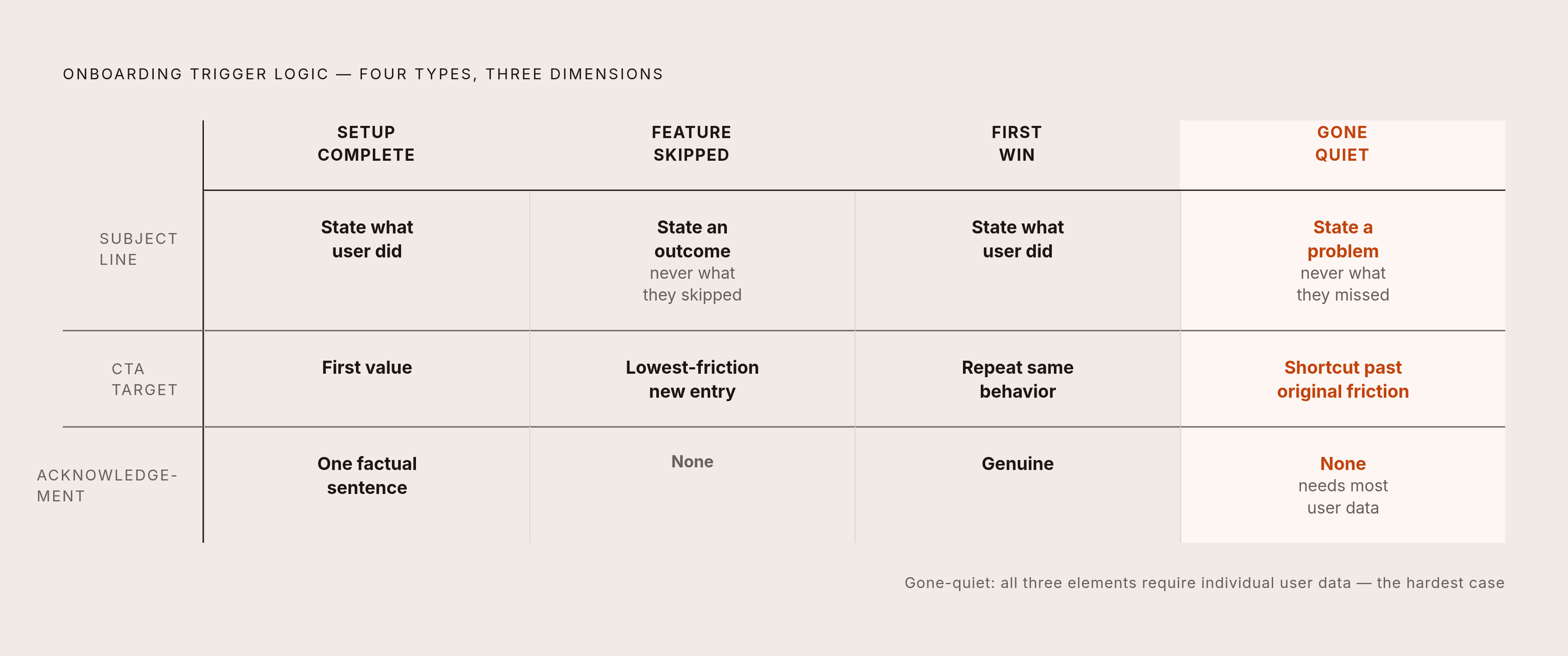
Four distinct trigger moments, but the same four or five elements shift in each one, and recognizing which elements move is more useful than memorizing four separate templates.
The subject line logic changes based on whether the trigger represents action or inaction. For setup-complete and first-win, the subject line states a fact about what the user just did or can now do. For feature-skipped and gone-quiet, the subject line states a problem or outcome, deliberately avoiding any direct reference to what the user didn't do.
The acknowledgment, if there is one, scales with the size of the user's accomplishment. Setup-complete gets a single factual sentence. First-win gets a genuine acknowledgment before the copy moves on. Feature-skipped and gone-quiet skip acknowledgment almost entirely, because there's nothing to acknowledge and naming the absence directly reads as surveillance.
The CTA always narrows to one action, but what that action produces changes by trigger. Setup-complete points toward first value. First-win points toward a repeat of the same behavior. Feature-skipped points toward the lowest-friction entry into something new. Gone-quiet points toward a shortcut past whatever friction caused the drop-off.
What gets left out matters as much as what goes in. All four trigger types benefit from cutting feature lists, product tours, and secondary links that give the user more than one thing to decide. The instinct to be thorough is the instinct that kills every one of these emails.
The amount of individual-user information required to write the email responsibly increases as the trigger moves from action to inaction, and peaks at gone-quiet, where the email can't be useful without knowing what that specific person actually tried before they stopped. That's the throughline across all four sections: the trigger tells you when to send, and the user's specific, individual state tells you what to say, and the two are never the same decision.