Sequencing Campaigns Around a New Feature Launch
Define adoption before launch, then sequence messages to users who are actually ready.

A team ships a feature they believe in. They've tested it, documented it, maybe even demoed it internally to applause. Then they send the announcement, email blast, in-app banner, release notes link, and watch adoption flatline. The feature sits there, built and working, while usage numbers barely move. This happens because the message arrives outside the user's current workflow, at a moment that has nothing to do with what that user is actually trying to do, and gets forgotten before it becomes relevant again. One documented case found that 60% of churn came from customers who had never adopted three core features. Most of those users didn't reject the feature. They never encountered it at the right moment to begin with. Teams tend to diagnose this as a marketing problem: wrong channel, wrong subject line, wrong call to action. The real cause sits one layer deeper. The message preceded the user's readiness, which makes it a sequencing error, not a copywriting one. Teams measure adoption against all active users instead of only the users who were eligible to adopt, a second failure that compounds the first. That denominator error makes adoption look worse than it is, and it buries the exact point where the sequence actually broke.
Defining "ready to receive a message" in product terms
Before any campaign sequence gets designed, the team needs a precise definition of the adoption event, the specific action that separates someone who genuinely adopted a feature from someone who merely saw it mentioned. Opening a dashboard is exposure. Saving a report built from live data is evidence of adoption. That distinction has to be built into the system before a single message goes out, or the sequence will keep rewarding the wrong signal.
Four things need to be pinned down before any outreach gets designed. First, the eligible user population: who actually has access to the feature and a real reason to use it. Second, the adoption event itself: the specific action that signals meaningful use, not just a click or a page view. Third, the adoption window: how long is reasonable to wait before concluding someone isn't going to adopt on their own. Fourth, a depth threshold: doing something once is trial, doing it repeatedly is adoption, and the sequence needs to know which one it's measuring.
The eligible-user denominator has to be locked in before the sequence ever launches. Feature adoption rate means users who completed the adoption event divided by eligible users, not divided by all active users in the product. Get that denominator wrong and the resulting number tells a completely different story, which leads teams to completely different, and often wrong, decisions about what's working.
Readiness itself comes from two things working together: current database state and behavioral history. A user's role, plan, configuration, and what they've already done inside the product are the real signal of whether they're ready for a given message. Calendar time tells you nothing. A user who signed up fourteen days ago and a user who signed up ninety days ago can be at the exact same point of readiness, or at completely different ones, and the only way to know is to look at what they've actually done.
How a behavior-gated sequence is structured across multiple touches
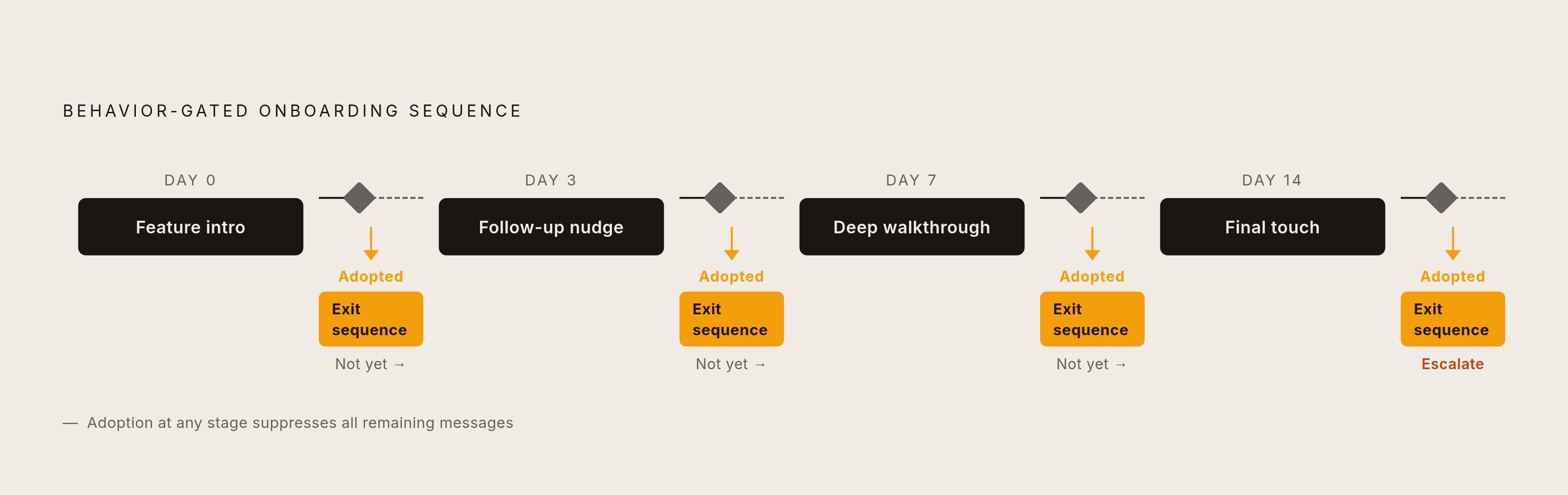
A behavior-gated feature launch sequence runs longer than most teams build, and it only moves forward when the user's in-product actions justify the next message, not when a timer on a calendar expires. The sequence needs to progress from awareness toward activation across several touches, and each touch has to gate on what happened after the one before it, rather than firing on a fixed schedule regardless of what the user did in between.
Picture the sequence laid out day by day. The sequence might open on Day 0 by introducing the feature to someone who's never touched it, while Day 3 might follow up only if that person hasn't engaged, with a more specific nudge tied to something they've done elsewhere in the product. Day 7 might offer a deeper walkthrough, but only to the subset still showing no sign of adoption. Day 14 might be the last touch in the awareness stage before the sequence either escalates to a different channel or stands down. The number of touches isn't the point. The gating logic between them is.
Users who complete the adoption event before any scheduled touch fires should skip every remaining awareness-stage message in the sequence. Sending a "get started" prompt to someone who has already started is the clearest possible sign that a sequence is running on a calendar instead of on behavior, and it's exactly the kind of mistake that erodes trust in the whole campaign.
Suppression logic matters as much as send logic, maybe more. Users who are already active on the feature, users who've opted out, and users for whom the evidence of readiness is weak or ambiguous shouldn't receive the next touch, even if the calendar says it's due. Once a product is live, retention engineering drives PLG B2B growth more than acquisition does. The practical implication is that this sequence needs to be designed before the feature launches, not stitched together reactively after adoption numbers come in low and someone asks what went wrong.
Branching the sequence by user starting point
A single linear sequence assumes every eligible user starts from the same place, but they never do. A user who's already deep in adjacent workflows, someone who's been using three related features for months, needs a completely different entry point than a user who's barely touched the product's core functionality. Sending both of them the same first message will leave one feeling condescended to and the other feeling lost.
Segmenting by starting point is not the same exercise as segmenting by persona or by plan tier. It means segmenting by current product state, which requires connecting two kinds of data: database state (role, plan, configuration) and behavioral history (what the user has and hasn't done inside the product so far). A user's plan tier tells you what they're allowed to do. Their behavioral history tells you what they're actually ready for, and the sequence needs to branch on the second thing, not just the first.
The obvious objection here is operational: maintaining four different sequences sounds like four times the work. It isn't, because the branches share the same adoption event definition and the same suppression logic across all of them. Only the entry point and the first message change from branch to branch. The underlying architecture, what counts as adoption, when to suppress a send, how deep is deep enough, stays identical. Branching is a design decision about where someone enters the sequence, not a request to rebuild the whole thing four separate times.
How AI adoption agents expand the sequence
Manual campaign sequencing can implement everything described above, for a handful of segments. A marketing team can write genuinely grounded, behavior-aware messages for three or four user segments and manage the gating logic by hand. What manual sequencing can't do is apply that same logic independently to every eligible user without collapsing individual differences into a segment average. An adoption agent can, because it investigates each person's actual product state and writes to what it finds there, rather than writing to an assumed average of a segment.
The constraint on manual sequencing comes down to a trade-off between personalization and scale. A team can produce a small number of genuinely grounded, specific messages in a day, or it can send a large volume of generic ones. It's hard to do both at once by hand. An adoption agent removes that trade-off, because it isn't writing one message for a thousand people, it's making a separate judgment call for each person based on what that person has actually done.
An agent operates inside a campaign that a human defines once, the goal, the eligible audience, the guidance, the limits, and then makes independent send-or-skip decisions for each person rather than executing a fixed, pre-written schedule. A human doesn't review and approve every individual message before it goes out. The campaign's guardrails govern every send, which is what makes the system trustworthy at scale.
Those guardrails need to be concrete, not aspirational. Frequency caps, quiet hours, never-contact flags, and skip-if-unsure logic all belong at the send gate itself, enforced by the system, rather than left to instructions buried in a prompt that can drift or get ignored under edge cases. Governing an agent well before it ever touches a live user is not optional. That means defining what the agent can read, what it can write, and what it's allowed to send, auditing its reasoning on a regular basis, and keeping a clear separation between observed post-message adoption and actual causal lift. Behavior change after a message went out is evidence that something happened. It is not proof the message caused it.
Measuring whether the sequence changes product behavior
A behavior-gated sequence has to be judged on whether it changed what users actually do in the product, not on whether they opened an email or clicked a link. Open rate and click rate measure whether a message got delivered and noticed. Neither one measures adoption, and treating them as a proxy for adoption is how teams end up optimizing the wrong thing for months at a time.
Among the eligible users who received the sequence, the share that completed the adoption event within the adoption window, compared against an equivalent eligible cohort that didn't receive the sequence, is the real measurement question. That comparison is what separates a sequence that's working from a sequence that happens to be running alongside users who would have adopted anyway.
The eligible-cohort denominator defined back at the sequence design stage is the exact same denominator used at measurement time. If the campaign targeted users with premium access to a given feature, adoption rate means completions divided by that eligible population, not completions divided by every active user in the product.
A few metrics belong at the center of this measurement, and each one checks a different part of the sequence's actual effect. Activation rate lift asks whether the sequence changed the share of eligible users who completed the adoption event. Time-to-activation asks whether the sequence shortened the gap between a user becoming eligible and that user actually completing the action. Email-to-product completion asks, of the users who clicked through, what share actually went on to complete the adoption event, since a click that never turns into an action in the product isn't adoption. Repeat key-action rate asks whether users who completed the adoption event once came back and used the feature again in a later period, or whether it was a single moment of exploration that never repeated. Retained adoption asks, among the cohort that activated on the feature, how many were still active on it in the measurement windows that followed.
None of this works without a real comparison group. Observed post-message adoption on its own is not proof of causal lift. A user who would have found and adopted the feature anyway, with or without the sequence, isn't evidence that the sequence did anything. A valid comparison cohort, eligible users deliberately held out of the sequence, is the only reliable way to separate what the sequence caused from what would have happened through organic discovery regardless. Teams that keep measuring opens and clicks will keep getting better at producing opens and clicks. Teams that measure adoption-event completion against a real eligible denominator will keep getting better at the thing that actually matters: changing what people do inside the product. The sequence's design and its measurement have to run on the same definition of success, or the numbers will tell a story that has nothing to do with whether the feature actually got adopted.