Subject Line Personalization Beyond First Name
The three tiers of email personalization show why first names no longer work and what replaces them.

First-name personalization used to signal effort. Now it signals nothing, because every sender does it, and a recipient's inbox has trained them to see "Hi [First Name]" as the mark of a mail merge, not a message written for them. The tool that once separated a thoughtful sender from a mass blast is now the baseline every sender clears without trying.
AI has made this worse, not better. Teams can generate thousands of first-name, company-name, job-title variations in seconds, and the subject line trends guide from Instantly for 2026 points out that the senders actually pulling ahead are using AI to find context about a recipient, not just to write copy faster. Running the same generic prompt everyone else runs produces output that reads like everyone else's output. Volume went up. Distinctiveness didn't.
Open rate made this problem harder to see, because for years it looked like token personalization was still working. That measurement has a hole in it now. Apple Mail Privacy Protection pre-loads tracking pixels on a large share of inboxes, which inflates open counts across the board, regardless of what the subject line actually says. GetReplies' 2026 analysis and Instantly's SaaS subject line guide both treat open rate as directional at best because of this, and both point senders toward reply rate as the better signal, with meetings booked as the real finish line.
Personalization itself didn't stop working. A cheaper, flatter version of it took over, and the metric senders used to judge it stopped telling them the truth. What comes next is a map of what actually produces a different result, from the token sitting at the bottom to the signal-based subject line at the top.
The three-tier framework: what separates token, segment, and signal-based subject lines
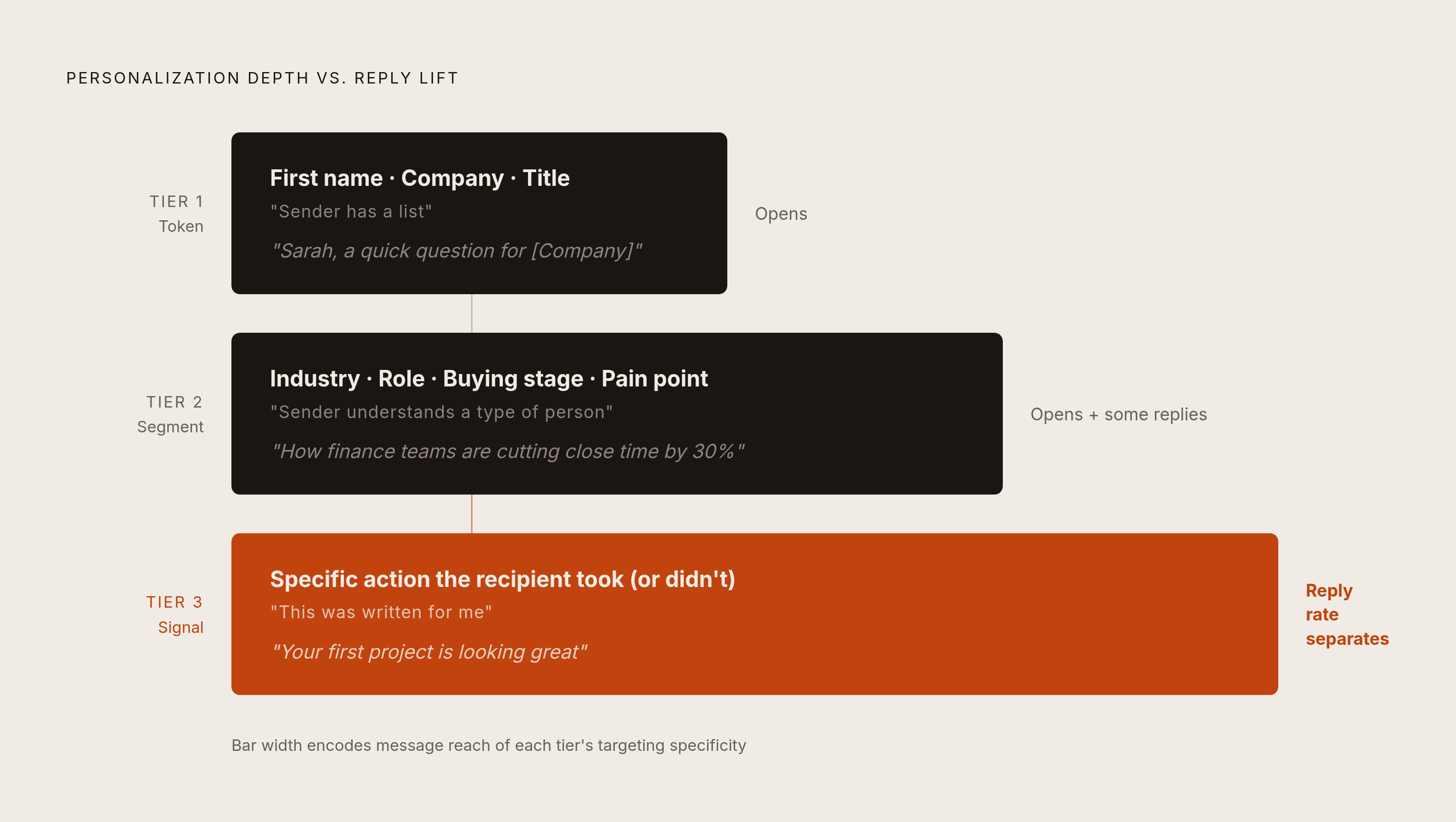
Personalization comes in three tiers, and the distance between them isn't just effort. Each tier proves something different to the person reading the subject line about whether the sender actually knows who they are.
Tier 1 is token personalization: a first name, a company name, a job title, dropped into a template through a merge field. It takes almost no work to produce at scale and requires no research into the individual recipient. All it proves is that the sender has a list and a mail tool that can read a column out of a spreadsheet.
Tier 2 is segment personalization: a subject line built for a persona, an industry vertical, a stage in the buying journey, or a product category. This takes real audience work, building out who the segments are and what each one cares about, but it doesn't require research into any single recipient. It proves the sender understands a type of person.
Tier 3 is signal- and behavior-based personalization: a subject line built from something the recipient specifically did, or specifically didn't do. This is the tier that proves the message was written for this person, not pulled from a list of people who look like them.
None of these tiers is wrong on its own. A cold list of ten thousand names calls for a different approach than a product user three days into a trial. The point of this framework isn't to rank the tiers by virtue, it's to show that moving up the ladder changes the kind of result a sender can expect, and to give a clear picture of where each tier earns its keep.
Tier 1 in practice: token personalization's limits
Token personalization earns its place in high-volume, low-cost outreach, where the list is large enough that researching each recipient individually isn't economically realistic. A sender working a list of fifteen thousand cold contacts cannot write a custom hook for each one. A first name and a company name, inserted automatically, at least clears the lowest bar of looking like it was addressed to a human being.
The ceiling on that approach is well documented. Autobound's synthesis of email performance data finds that personalization beats generic subject lines consistently, across every dataset it looked at, and that the personalization doing the most work goes well past a first name. The subject lines that perform reference something the recipient actually cares about.
Weak relevance also compounds with a deliverability problem. Instantly's 2026 guide notes that Google, Yahoo, and Microsoft have tightened enforcement against deceptive sending patterns. The old workarounds, a fake reply-thread prefix, urgency language, exaggerated formatting, were tricks senders used to compensate for a subject line that had nothing real to say. Spam filters now penalize those tricks directly. The fallback options that used to prop up a weak token-only subject line are closing off.
In practice, a first-name token works when everything around it is doing the relevance work: a tightly targeted list, a message built on a specific, well-understood pain point, an offer that doesn't need a demographic to land. It stops working the moment the token is the only personalization in the message, expected to carry relevance on its own. And that raises the obvious next question: what happens when the sender understands not just a name, but a type of person?
Tier 2 in practice: where segment personalization plateaus
Segment personalization moves the needle without requiring research on each individual recipient. A subject line tuned to an industry, a role, a stage in the buying cycle, or a known pain point reads as relevant to a whole group of people, and it scales the same way a token does, through a template, just a smarter one.
Picture the difference directly. A tier-1 line might read "Sarah, a quick question for [Company]." A tier-2 line, aimed at the same recipient but built around her role, might read "How finance teams are cutting close time by 30%." That second line is doing real work. It shows the sender understands something about the category Sarah belongs to.
The ceiling sits exactly where that description ends. A segment-level subject line proves the sender understands a type of person. It doesn't prove the sender understands this specific person, and that distinction is what separates a subject line that gets opened out of mild relevance from one that gets a reply out of recognition.
The plateau is visible sharpest in product messaging, where generic persona-based lines still dominate. A line like "Here's how product managers get more from [feature]" is a tier-2 line: well-targeted, persona-aware, and still generic to everyone who shares that job title. A line built on what this specific user actually did inside the product is a different animal entirely, because the first signals category knowledge and the second signals attention. Segment work is necessary. It just isn't sufficient to produce the strongest reaction a subject line can produce.
Tier 3 in practice: signal- and behavior-based subject lines
Signal-based subject lines work because they answer a question before the recipient even opens the email: why me, why now? A subject line that references a specific action, a specific event, or a specific gap in behavior proves, in the eight or ten words before the inbox preview cuts off, that this message was written for one person and not pulled from a segment.
For SaaS product teams and product-led growth motions, the strongest signal is usually something the user did, or didn't do, inside the product itself, rather than external news about the company or the industry. Compare "Hi Sarah, here's what to do next," a tier-1 line with a token stapled onto generic advice, against "Your first project is looking great." The second line only makes sense if the sender is actually watching what Sarah built. It doesn't generalize to anyone else, and that specificity is exactly the point.
Sequenzy's guide to SaaS email personalization states this directly: personalizing based on behavior or in-product status carries more weight than personalizing on name, because it proves the sender is paying attention to what the recipient is actually doing, not running a scheduled sequence that happens to include a merge field.
The signal has to be accurate for any of this to work. This is where a denominator problem enters: a behavior-based subject line referencing a feature the recipient cannot access, or is ineligible for under their plan, produces the opposite of the intended effect. Instead of "this sender is paying attention," the recipient reads "this sender doesn't actually know anything about me," which is a worse position than a generic tier-1 line would have left them in.
That's also why human review stays part of the process at this tier, even with AI doing the drafting. Instantly's 2026 guide names three specific failure modes: timing insensitivity, like referencing a company's funding round in the same week it announces layoffs; hallucination, a hook built on a fact that isn't true; and language that reads as obviously robotic despite the personalization. The guide's rule is direct: AI drafts at scale, and humans approve before anything sends. Any subject line that references a named event or a specific metric needs a human to confirm the fact is right before the sequence goes out. That review step isn't the point of tier 3, it's the guardrail that keeps tier 3 from backfiring.
What to measure instead of opens
None of the three tiers can be judged fairly on open rate anymore. Apple Mail Privacy Protection pre-loads tracking pixels across a large share of the inbox, inflating open counts regardless of what tier produced the subject line or how sharp the signal was. GetReplies' 2026 analysis and Instantly's 2026 guide both land on the same conclusion from different angles: reply rate is the real signal for cold outreach, and for Instantly specifically, meetings booked is the metric that actually matters.
For SaaS lifecycle and product messaging, the equivalent shift moves the needle past email. In-product event completion, whether the recipient actually did the thing the email pointed at, is the primary signal. Click-through on the email itself is secondary. Open rate is a distant third, useful mostly as a rough directional check.
There's a deeper distinction product and growth teams need to hold onto here: activation isn't adoption. A user who opens an email and clicks through to a feature has been activated. A user who comes back to that feature on their own, without a prompt, and folds it into how they actually work, has adopted it. Measuring only the first one overstates what a personalization campaign actually accomplished, because a click is easy to produce and easy to forget.
Eligible-cohort discipline matters just as much. Measuring adoption of a feature against the entire user base, when that feature only applies to certain plans or certain roles, deflates the number and tells a misleading story. The denominator has to be the users who could have adopted the feature in the first place, not every user on the account.
How a prescriptive approach differs from descriptive personalization tools
Most personalization tools stop at descriptive, or at best segmented, work. They tell a sender what's true about an audience, a market, or a demographic, or they let a sender drop a token into a template. Either way, the sender still has to decide what the message should say and whether now is the right time to send it.
A prescriptive approach works differently. It combines current database state, who the person is, what plan they're on, what role they hold, what configuration they've set, with behavior over time, what they did, what they skipped, what they started and never finished. The gap between those two things, between what a person's account setup suggests they should be doing and what they're actually doing, becomes the signal driving the subject line. That gap is a sharper, more durable source of relevance than a persona label or a first name will ever be.
The objection that AI personalization has become generic at scale deserves a direct answer, because it's a fair one. If every sender runs the same AI prompt to produce a subject line, the output looks identical to everything else sitting in the inbox, no matter how the prompt is worded. Generic inputs produce generic outputs, regardless of which tool wrote the sentence.
Better material fed to the prompt in the first place, behavioral context pulled from real product events and real database state, is what fixes this. That's the line that separates a subject line genuinely built on a signal from one more piece of AI-generated noise wearing a first name.